
Tangible Personal Property Information
On this page
What Is Tangible Personal Property?
Tangible Personal Property (TPP) refers to physical assets used in a business or income-producing activity. Common examples include machinery, equipment, computers, office furniture, fixtures, signs, and business supplies. It may also include leased, loaned, borrowed, or rented equipment, certain appliances and furnishings in rental properties, and certain mobile home attachments located on rented land.
Who Is Required to File?
Businesses and individuals who own taxable tangible personal property as of January 1 must file a Tangible Personal Property Tax Return (Form DR-405) with the Property Appraiser in the county where the property is located. This includes sole proprietors, partnerships, corporations, self-employed individuals, and owners of property leased, loaned, borrowed, or rented for business use.
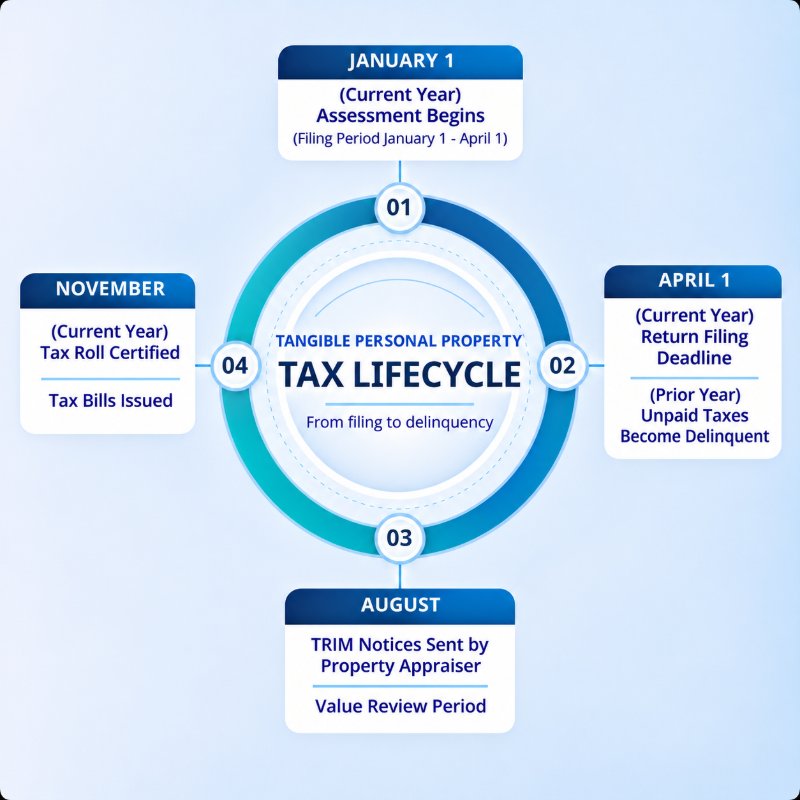
Read the lifecycle as text
- January 1: assessment date; the filing period runs January 1 to April 1.
- April 1: return filing deadline; prior-year unpaid taxes become delinquent.
- August: TRIM notices are sent by the Property Appraiser and the value review period begins.
- November: the tax roll is certified and tax bills are issued.
When to File?
January 1 is the annual assessment date. The standard deadline for filing Form DR-405 is April 1 of that same year, unless an approved extension or another applicable filing exception applies. Returns should accurately report the property and its status as of January 1.
Late, incomplete, or missing returns may lead to statutory penalties. Under Florida Law, the general penalties include:
- Failure to file: 25% of the tax levied against the property.
- Late filing: 5% per month or portion of a month, up to 25% of the tax.
- Unreported property: 15% of the tax attributable to the omitted property.
Failing to file a return does not eliminate the responsibility to pay taxes assessed against the property.
The $25,000 TPP Exemption
Florida provides an exemption of up to $25,000 of assessed tangible personal property value for qualifying returns. A timely filed DR-405 generally serves as the application for this exemption. This is an exemption from taxable value, not a $25,000 credit against a tax bill.
Assessment Notices and the Review Period
The County Property Appraiser determines the value of taxable tangible personal property and generally mails the Notice of Proposed Property Taxes, commonly called the TRIM Notice, in August. Taxpayers should review this notice promptly and verify that the reported value and account information are accurate.
Questions or disagreements about an assessment should be raised during the normal assessment-review period. The ordinary deadline to petition an assessment is 25 days after the Property Appraiser mails the TRIM Notice. This review window normally occurs in late summer or early fall, well before the tax becomes delinquent.
By the time an account becomes delinquent, the normal administrative assessment-review period has passed. Delinquency does not create a new opportunity to reopen an expired filing period. Any legally available correction or exception must be addressed with the appropriate county office; taxpayers should not assume that a pending inquiry suspends the amount due or collection activity.
Tax Bills and Payment
Tax Collectors mail annual property tax bills in November, after receiving the certified tax roll. Payment is made directly to the County Tax Collector. Keeping current mailing and business information on file with the appropriate county office helps ensure that notices and billing information reach the correct party.
When Does TPP Become Delinquent?
Unpaid taxes generally become delinquent on April 1 of the year following the assessment year.
Delinquent accounts may incur interest, statutory fees and costs, and collection or enforcement action as authorized by Florida law. Tax liens and statutory warrant procedures may apply to delinquent TPP accounts.
Enforcement of Delinquent Taxes
Florida law provides County Tax Collectors with statutory authority to pursue enforcement actions for unpaid Tangible Personal Property taxes. These measures are intended to facilitate the recovery of delinquent taxes and ensure compliance with applicable tax obligations.
Revenue Recovery Solutions, acting as an authorized agent on behalf of the respective County Tax Collector, assists in coordinating, managing, and overseeing enforcement activities in accordance with applicable Florida statutes and under the direction of the Tax Collector.
Our approach emphasizes voluntary resolution and taxpayer education whenever possible, while supporting the County's authority to pursue lawful enforcement measures when necessary.
Revenue Recovery Solutions and Delinquent Accounts
Revenue Recovery Solutions serves as a contracted agent on behalf of Florida County Tax Collectors, assisting with the recovery of delinquent tangible personal property taxes pursuant to Florida Statute § 197.332. Our work includes taxpayer communication, account follow-up, collection support, and education about the steps available to address an outstanding balance.
Property valuation, assessment changes, and exemption determinations remain with the County Property Appraiser. Tax payments are made directly to the respective County Tax Collector, not to Revenue Recovery Solutions.
All tax payments are made directly to the respective County Tax Collector,
not to Revenue Recovery Solutions.