
Business Tax Receipt Information
On this page
What Is a Business Tax Receipt?
A Business Tax Receipt (BTR), formerly commonly referred to as an Occupational License, is a local tax receipt issued by a county or municipality for the privilege of conducting business within its jurisdiction.
Business Tax Receipts are governed by Florida Statutes Chapter 205, along with applicable county and municipal ordinances.
A BTR serves as proof of compliance with the local business tax requirements. However, it does not replace any additional professional licenses, regulatory permits, zoning approvals, or other authorizations that may be required to operate a business.
Who Is Required to Obtain a Business Tax Receipt?
Individuals, businesses, corporations, partnerships, and other entities conducting business within a jurisdiction that imposes a local business tax are generally required to obtain and maintain a valid Business Tax Receipt, unless an applicable exemption exists.
Requirements may vary depending on the nature of the business, its location, and the governing county or municipal ordinances.
Businesses located within municipal boundaries may be required to obtain both a County Business Tax Receipt and a separate Municipal Business Tax Receipt.
Business owners should contact the appropriate Tax Collector or local licensing office to verify their specific requirements.
Business Tax Receipt Renewal and Expiration
Business Tax Receipts are issued annually and must be renewed to remain current.
Pursuant to Florida Statute §205.053, the annual renewal schedule is as follows:
- July 1: Business Tax Receipt renewals become available.
- September 30: Deadline for payment and renewal, and expiration date of the current receipt.
- October 1: Unrenewed accounts become delinquent under the standard annual schedule.
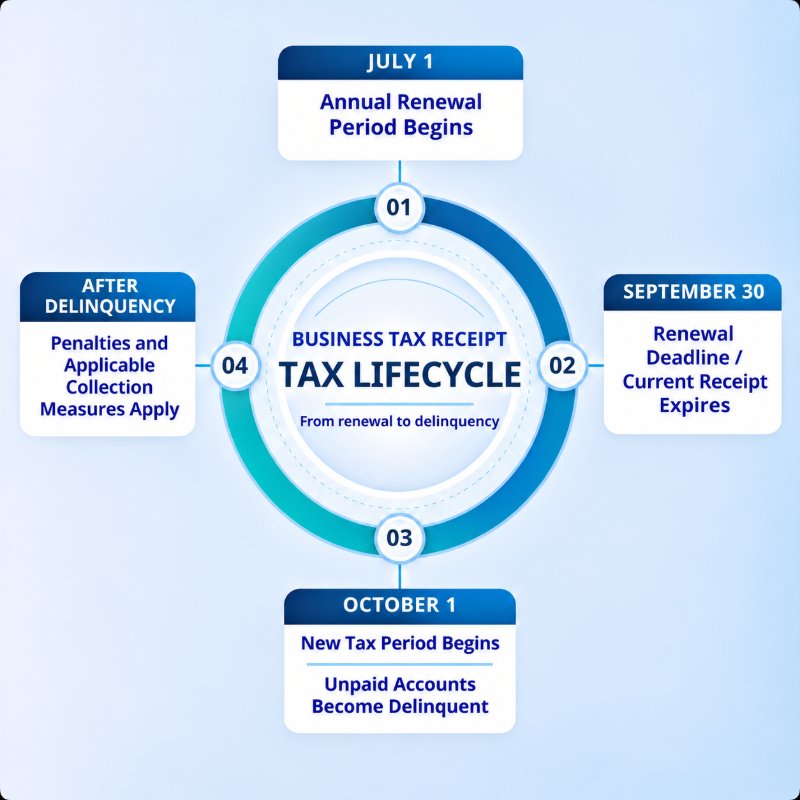
Read the lifecycle as text
- July 1: the annual renewal period begins.
- September 30: renewal deadline; the current receipt expires.
- October 1: the new tax period begins and unpaid accounts become delinquent.
- After delinquency: penalties and applicable collection measures apply.
Understanding the Renewal Period
Business Tax Receipts are renewed in advance for the upcoming annual tax period, which runs from October 1 through September 30.
For example, a Business Tax Receipt renewed in July 2026 is for the annual period beginning October 1, 2026, and ending September 30, 2027.
Timely renewal is essential to maintaining compliance with local business tax requirements and avoiding additional penalties.
When an Account Becomes Delinquent
Business Tax Receipts that are not renewed by the required deadline become delinquent and are subject to statutory penalties. Penalties begin up to 25% and may include additional legal costs and penalties pursuant to Florida Law.
Additional penalties and legally recoverable costs may apply under separate statutory provisions or applicable local ordinances.
Failure to renew a required Business Tax Receipt does not eliminate the outstanding tax obligation.
Additional Penalties for Noncompliance
Florida law also establishes additional consequences for conducting business without a required Business Tax Receipt.
Under Florida Statute §205.053(2), a person conducting or managing a business without first obtaining the required receipt is subject to a penalty of 25% of the tax due, in addition to other penalties authorized by law or ordinance.
Furthermore, pursuant to Florida Statute §205.053(3), a person who fails to pay the required business tax within 150 days after the initial notice of tax due and fails to obtain the required receipt may be subject to civil actions and additional penalties, including:
- Court costs and reasonable attorney's fees.
- Additional administrative costs associated with collection efforts.
- An additional penalty of up to $250.
The assessment of additional costs or penalties depends on the applicable statutory requirements and collection proceedings.
Enforcement of Delinquent Business Tax Receipts
Florida law provides local governments with enforcement options to address unpaid Business Tax Receipts and violations of local business tax requirements.
These enforcement measures may arise under two separate legal authorities.
1. State Statutory Enforcement
Florida Statutes Chapter 205 establishes the authority to impose local business taxes, assess delinquency penalties, and pursue authorized civil collection measures when statutory requirements are met.
2. County and Municipal Ordinance Enforcement
In addition to state law, counties and municipalities may adopt ordinances regulating local business tax requirements and establishing procedures for compliance.
Depending on the jurisdiction and applicable ordinance, enforcement may involve compliance notices, code enforcement proceedings, citations, administrative penalties, or other legally authorized measures.
Revenue Recovery Solutions, acting as a contracted collection agent on behalf of the respective County Tax Collector, assists in managing and coordinating delinquent Business Tax Receipt collection efforts in accordance with applicable Florida statutes, local ordinances, and the direction of the Tax Collector.
Our approach emphasizes taxpayer education, communication, and voluntary resolution while supporting the County's authority to pursue lawful collection measures when necessary.
Business Closures, Changes, and Exemptions
Business owners should promptly notify the appropriate county or municipal office of changes affecting their Business Tax Receipt, including a business closure, relocation, ownership change, or modification of business operations.
Closing or relocating a business does not automatically eliminate outstanding tax obligations from prior periods.
Resolving a Delinquent BTR Account
Revenue Recovery Solutions assists participating Florida County Tax Collectors and municipalities with delinquent BTR collection efforts and provides information to help taxpayers understand their outstanding obligations and available steps toward resolution.
Our team can assist with account inquiries, collection-related questions, and directing taxpayers to the appropriate county resources.
All tax payments are made directly to the respective County Tax Collector,
not to Revenue Recovery Solutions.